
A charger that immediately dumps 1C into whatever is inserted will eventually destroy a battery, because the cells that most need charging - deeply discharged, frozen in a car boot, or hot from a discharge - are precisely those least able to accept high current. Production fast chargers therefore front-load a set of qualification gates that must all open before fast current is permitted. This paper details the voltage gate that detects and rescues deeply discharged cells, the thermal gate that enforces a cold-to-hot admissible window via the NTC, and the consistency checks that protect mismatched or faulty strings, showing how the bq2002-class inhibit logic implements them and why skipping qualification converts fast charge into a reliability hazard.
A deeply discharged NiMH cell can read below a volt, may show reversed polarity in a mismatched string, and cannot safely accept 1C: its electrodes need re-forming and its internal state is poorly known. The qualification stage measures open-circuit and loaded voltage; below a threshold the controller applies only a small conditioning (pre-)charge until voltage rises into the normal band, then ramps to fast current. The bq2002 explicitly inhibits fast charge when battery voltage is outside its limits, forcing this gentle path.
Pre-charge doubles as a fault test: a cell whose voltage fails to rise under small current within a timed window is declared defective - shorted, reversed or at end of life - and fast charge is refused rather than forced, protecting both the cell and the charger from the heating that high current into a shorted cell would cause.

Fast charge is permitted only inside a temperature band. At the cold end - near and below 0 C - electrolyte kinetics and oxygen recombination slow sharply, so high current builds pressure before the cell can recombine; at the hot end - commonly above about 45 C approaching the 50 to 60 C absolute limits - degradation accelerates and the -delta-V signal vanishes. The NTC-derived Vtemp is compared against cold and hot thresholds and fast charge is withheld or reduced outside the window.
Rather than simply refusing a cold pack, sophisticated chargers apply a low conditioning current whose I-squared-R heat gently brings the cell into the admissible band before ramping - a controlled warm-up - while a hot pack is simply allowed to rest, since adding current would worsen the condition. The gate is therefore a state-dependent current limiter, not a binary lockout.
Beyond absolute temperature, qualification examines the sensor itself: an open or shorted NTC reads as an extreme voltage and must be treated as a fault that forbids fast charge, never as 'cold' (open) that permits it; the temperature-rise rate before fast current is even applied can reveal a cell already hot from prior use. Charge ICs implement these as explicit Vtemp comparison ranges with fault outputs driving the LED and the power path off.
Voltage qualification similarly watches for implausible readings for the configured cell count - a four-cell pack reading two cells' worth of voltage indicates a damaged cell or connection - and refuses fast charge rather than charging blind.
Once gates open, current should rise under control rather than snapping to 1C, because an instantaneous current step creates a voltage jump that can be misread as a peak and a thermal shock through the electrodes. A controlled ramp lets the controller confirm voltage and dT/dt remain benign at each level, and establishes a clean baseline from which the peak register and slope detectors can operate - the same current-stability requirement that solar-charger research imposes when it holds the peak register during input transients.
Multi-stage profiles (Paper 2) extend this idea through the whole charge: qualification gates open the fast phase, and descending current steps keep the cell inside its acceptance and thermal envelope as it fills, so 'prerequisites' recur at every stage transition rather than being a one-time start-up check.
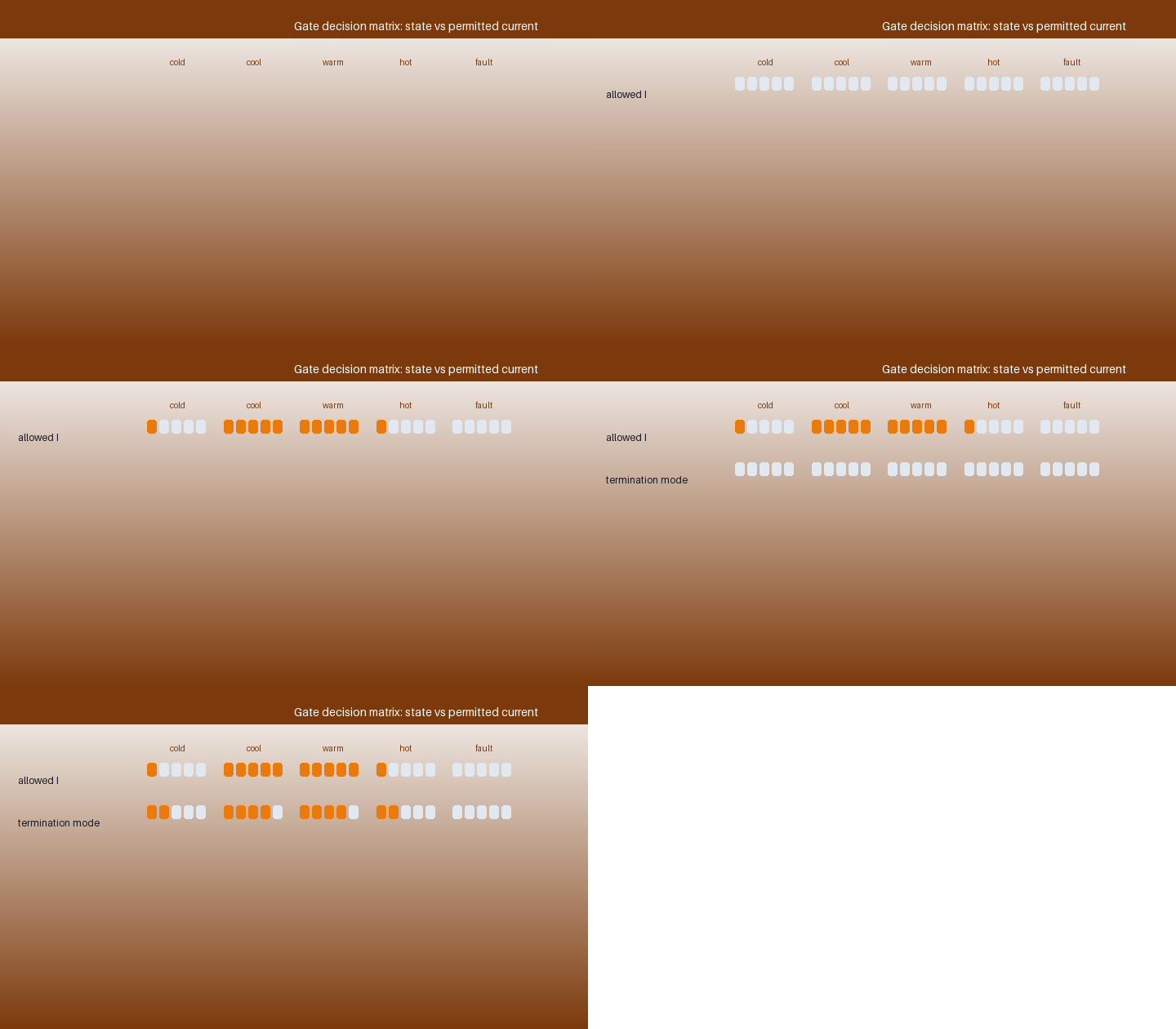
Each failed gate has a defined response: deep discharge triggers timed pre-charge and a fault if it does not clear; cold triggers conditioning or wait; hot triggers rest; sensor fault disables charging; cell-count mismatch flags an error. Status indication distinguishes 'charging' from 'waiting to charge' from 'fault', so a warm pack cooling before fast charge is not mistaken for a broken charger. The first figure sequences the gates; the second is a decision matrix mapping measured state to permitted current.
This deterministic gate logic is what allows a charger to be left unattended - the normal consumer and industrial case - without risking high current into a cell that cannot take it.
Validation must exercise every gate boundary in a thermal chamber and with electronic loads that emulate deep-discharged, reversed, shorted and mismatched strings, confirming current is withheld or reduced until each gate legitimately clears and that a genuine fault is never overridden by time pressure. Boundary hysteresis prevents chatter as temperature or voltage sits on a threshold.
Weijiang provides the cold/hot charge envelopes and recovery behaviour for each cell grade, allowing partners to set gate thresholds that match real cell kinetics rather than generic IC defaults. With the gates defined, the next paper examines a technique that widens the safe fast-charge envelope itself: interrupting current to give the gas-recombination process a window to catch up.
Weijiang Power designs and manufactures nickel-metal hydride cells, matched packs and charging-ready configurations for consumer, industrial, medical and mobility customers, and supports partners with charge-protocol guidance, IEC 61951-2 performance files, IEC 62133-1 safety evidence and charger co-validation. Share your cell format, charge rate, thermal envelope and cycle target and our engineers will specify a cell-and-charge combination that protects both runtime and service life. Review the range on the products page.


