Every consumer claim - 'holds 70 percent after ten years', 'up to 2100 recharges', 'pre-charged and ready' - is only as credible as the standard behind it. This validation paper explains how IEC 61951-2 actually measures the parameters that matter for a low-self-discharge nickel-metal hydride cell, how a laboratory sequences the retention, recovery and cycle-endurance tests, and how a manufacturer should word a long-storage or long-cycle claim so it survives scrutiny by a European retailer or regulator. It closes the loop between the materials science in Paper A and the selection method in Paper B.
IEC 61951-2:2017 organises portable sealed NiMH testing into a logical sequence of standard charge and discharge conditions, discharge performance at 20 degrees C and at 0 degrees C, rapid-charge performance for R-designated cells, charge retention, endurance in cycles and endurance under permanent charge, constant-voltage charge acceptance and overcharge tolerance. Every test references a defined standard charge and a defined end voltage - commonly 1.0 V per cell for discharge - so results are comparable between suppliers. The discipline for a consumer line is to declare the exact edition, temperature, current and end voltage used, because a number without those conditions cannot be compared or audited.

Charge retention is measured by fully charging a cell under the standard regime, storing it for a defined period at a controlled temperature, then discharging it without an intervening recharge and expressing the delivered capacity as a percentage of rated or initial capacity. IEC 61951-2 includes short standard storage intervals (such as 28 days) as the reproducible laboratory anchor; manufacturer long-storage claims - for example retaining about 70 percent after years of proper storage at moderate temperature - are extrapolated from accelerated and long-run programmes and must be labelled with the method and conditions, as leading LSD brands do by citing clause 7.3.2. Conflating a 28-day standard test with a ten-year marketing claim is the most common documentation error.
Charge recovery follows the same stored cell but gives it a standard recharge before the discharge, again expressing capacity as a percentage. The pairing of retention (discharge straight from storage) and recovery (recharge first, then discharge) separates two different user experiences - grabbing a stored cell and using it immediately versus recharging it before use - and reveals whether storage caused reversible depletion or irreversible fade. A robust LSD design shows modest retention loss that is almost fully restored on recharge across repeated storage episodes. Reporting both numbers, rather than only the more flattering one, is the mark of a defensible datasheet.
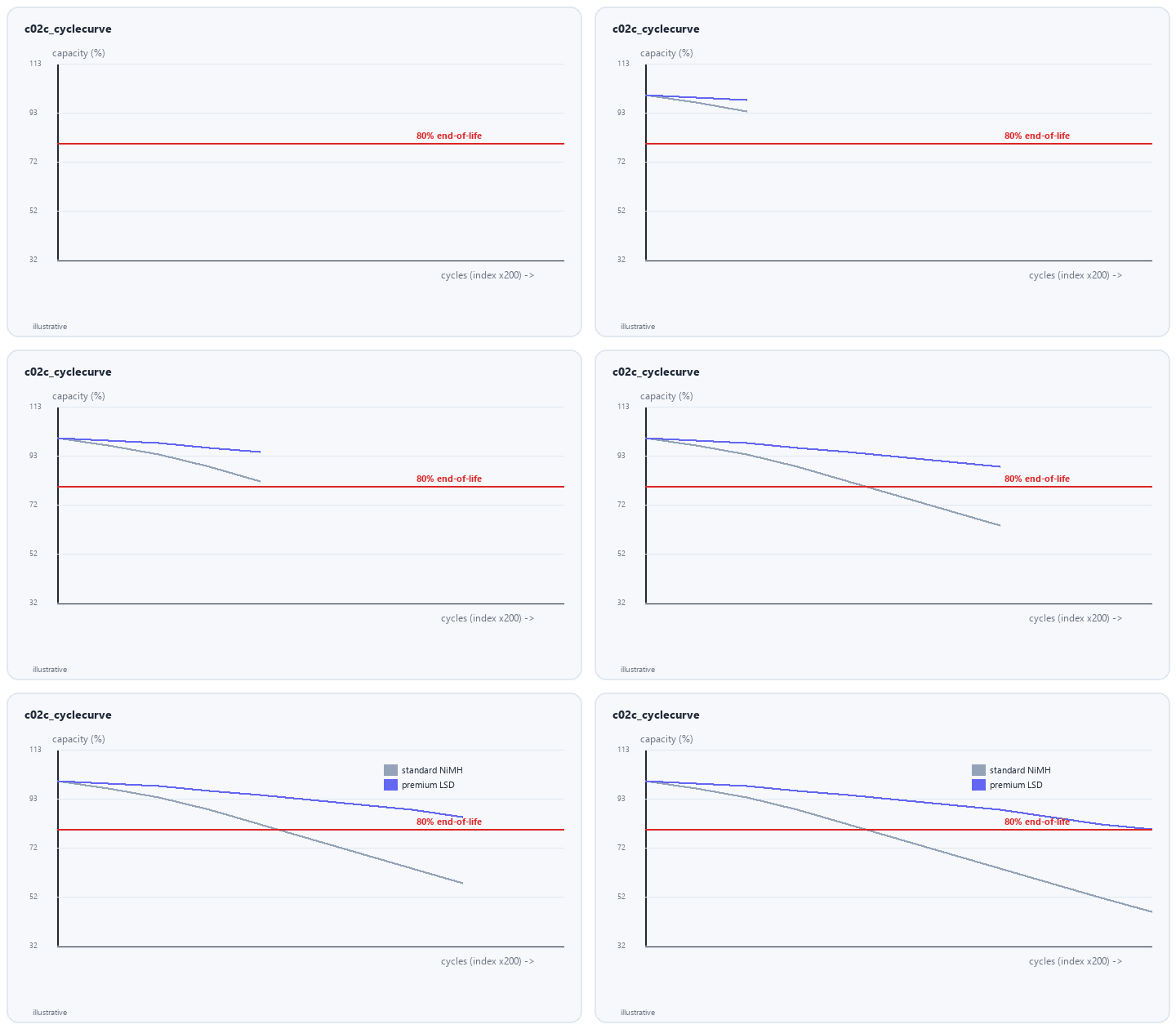
Endurance in cycles repeats defined charge-discharge blocks and checks the discharge duration on every fiftieth cycle against a minimum threshold; the test continues until that duration falls below the limit, giving the cycle count. Conditions - current, temperature, rest and end voltage - dominate the result, which is why a '2100-cycle' figure from a gentle low-rate regime and a '500-cycle' retail figure from a faster regime can both be honest yet look wildly different. The validation discipline is to publish the cycle curve and the 80-percent-style end criterion together, never a bare maximum, and to match the test regime as closely as possible to the real consumer charge profile.
Household reality is harsher than a bench: cells sit in hot cars, sit in cheap chargers on maintenance current, and are occasionally overcharged. IEC 61951-2 therefore includes charge and discharge at elevated temperature, trickle-charge acceptance for cylindrical formats and overcharge tests. An LSD cell that passes retention but degrades under permanent charge will disappoint in a docked device, so the validation plan should combine the headline retention and cycle tests with the trickle and temperature cases that mirror real chargers and environments. These tests also feed the IEC 62133-1 safety dossier, avoiding duplicated laboratory effort.
The animated test sequence below steps through standard charge, storage, retention discharge, recharge, recovery discharge and repeated cycling to the endurance threshold. From it, a defensible claim follows a fixed grammar: parameter, value, standard clause, temperature, current, end voltage and storage or cycle conditions. 'Retains up to 70 percent of charge after ten years when unused and properly stored, based on the IEC 61951-2 method' is defensible; 'lasts ten years' standing alone is not. Building consumer marketing and retail tender documents from this grammar is how a NiMH supplier turns a genuine materials advantage into evidence a European buyer can sign without legal hesitation.
Weijiang Power tests and documents consumer NiMH cells to IEC 61951-2 with retention, recovery, cycle-endurance, trickle and temperature reports, worded as audit-ready claims for European retail. Send your target claim and storage regime and we will design the validation programme and datasheet language behind it.


